Showing posts with label consumption. Show all posts

Saturday, September 01, 2012

Brand identity


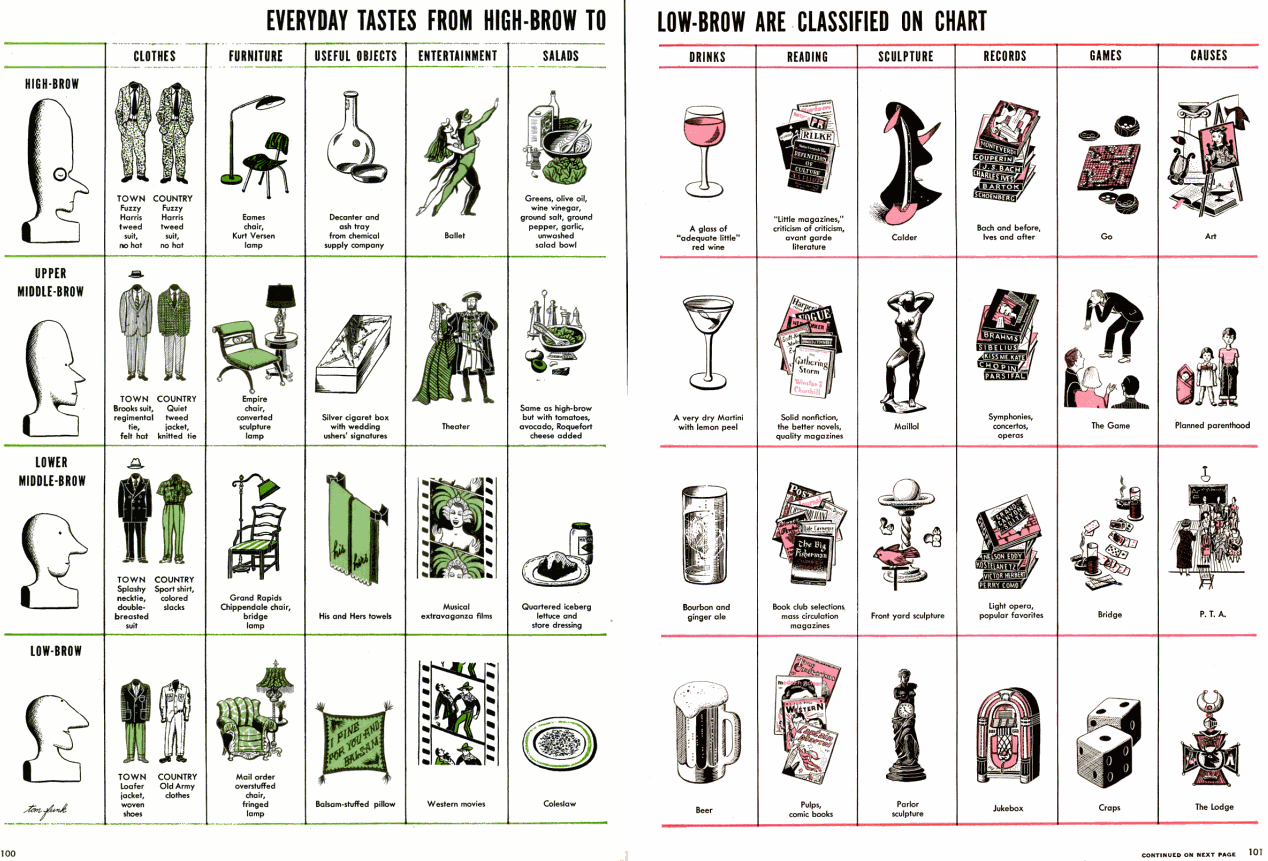
A hierarchy of tastes: the US, 1949

Long before Bourdieu published his essential book Distinctions, Life magazine, in 1949, published this chart, of High-Brow, Upper Middle-Brow, Lower Middle-Brow and Lowbrow tastes. I found it courtesy the blog of Kieran Healey.

Drinks: High = 'adequate little' red wine. Upper Middle = v. dry martini w/ lemon peel. Lower Middle = bourbon & ginger ale. Lower = beer.

And so on.

Click here for a larger version.


Sunday, July 08, 2012

The New Elitists: Cultural Omnivores

 
Craig Ward

Sociologist Shamus Khan, writing in the New York Times, July 8, 2012, on the tastes of today's elite. Some excerpts:

Poorer people are likely to have singular or “limited” tastes. The rich have the most expansive...Today’s elites are not “highbrow snobs.” They are “cultural omnivores.” 

Omnivorousness is part of a much broader trend in the behavior of our elite, one that embraces diversity...Diverse and populist programming is a mainstay of every museum. Elites seem more likely to confront snobbish exclusion than they are to embrace it...

To talk of “elite culture,” it seems, is to talk of something quaint, something anti-American and anti-democratic. Whereas the old elites used their culture to make explicit the differences between themselves and the rest, if you were to talk to members of the elite today, many would tell you that their culture is simply an expression of their open-minded, creative, ready-to-pounce-on-any-opportunity ethic. Others would object to the idea that they were part of an elite in the first place.  

But if you look at the omnivore from another point of view, a far different picture emerges.
Unlike the shared class character of Gilded Age elites, omnivores seem highly distinct and their tastes appear to be a matter of personal expression. Instead of liking things like opera because that’s what people of your class are supposed to like, the omnivore likes what he likes because it is an expression of a distinct self. Perhaps liking a range of things explains why elites are elite, and not the other way around. 

By contrast, those who have exclusive tastes today — middle-class and poorer Americans — are subject to disdain...

so if elites have a culture today, it is a culture of individual self-cultivation. Their rhetoric emphasizes such individualism and the talents required to “make it.” Yet there is something pernicious about this self-presentation. The narrative of openness and talent obscures the bitter truth of the American experience. Talents are costly to develop, and we refuse to socialize these costs. To be an outstanding student requires not just smarts and dedication but a well-supported school, a safe, comfortable home and leisure time to cultivate the self. These are not widely available...

Today America has less intergenerational economic mobility than almost any country in the industrialized world; one of the best predictors of being a member of the elite today is whether your parents were in the elite. The elite story about the triumph of the omnivorous individual with diverse talents is a myth...


[elites today] deploy that cultural difference to suggest that the inequality and immobility in our society is deserved rather than inherited.


Monday, April 16, 2012

Consumption and US voting trends

Amazing article from the New York Times, April 16. Viewers of the Golf Channel trend strongly Republican and have a very high turnout rate. Viewers of VH1 trend strongly Democrat and have a very low turnout rate. Those who eat at Cracker Barrel trend strongly Republican and turn out in big numbers. Those who eat at Church's Chicken are low-turnout, strong Democrats. Amstel Light drinkers are strongly Republican, Cognac drinkers strongly Democrat. And on it goes. Here's one of the very interesting charts.

Scotch, as the article observes, is a 'centrist' drink.

Sunday, December 27, 2009

Disney targets boys, $50 billion at stake

"Disney Expert Uses Science to Draw Boy Viewers," by Brookes Barnes, New York Times, April 13, 2009, pp. A1, A 14. Some experts.

Ms. [Kelly] Peña and her team of anthropologists have spent 18 months peering inside the heads of incommunicative boys in search of just that kind of psychological nugget. Disney is relying on her insights to create new entertainment for boys 6 to 14, a group that Disney used to own way back in the days of “Davy Crockett” but that has wandered in the age of more girl-friendly Disney fare like “Hannah Montana”...

Fearful of coming off as too manipulative, youth-centric media companies rarely discuss this kind of field research. Disney is so proud of its new “headquarters for boys,” however, that it has made an exception, offering a rare window onto the emotional hooks that are carefully embedded in children’s entertainment. The effort is as outsize as the potential payoff: boys 6 to 14 account for $50 billion in spending worldwide, according to market researchers...

media companies over all have struggled to figure out the boys’ entertainment market...The guys are trickier to pin down for a host of reasons. They hop more quickly than their female counterparts from sporting activities to television to video games during leisure time. They can also be harder to understand: the cliché that girls are more willing to chitchat about their feelings is often true...

In Ms. Peña’s research boys across markets and cultures described the television aimed at them as “purposeless fun” but expressed a strong desire for a new channel that was “fun with a purpose...