Tuesday, December 31, 2013

Martha Rosler: Bringing the (Vietnam) War Home

Cleaning the Drapes


Rosler conceived Bringing the War Home during a time of increased intervention in Vietnam by the United States military. Splicing together pictures of Vietnamese citizens maimed in the war, published in Life magazine, with images of the homes of affluent Americans culled from the pages of House Beautiful, Rosler made literal the description of the conflict as the "living-room war," so called in the USA because the news of ongoing carnage in Southeast Asia filtered into tranquil American homes through television reports. By urging viewers to reconsider the "here" and "there" of the world picture, these activist photomontages reveal the extent to which a collective experience of war is shaped by media images.  (Text from MoMA.)

Balloons

View more in this amazing series here.

Friday, November 15, 2013

Bronx Photos

Some great photos of the South Bronx here, dating from the early hip-hop era.

Here's hip-hop pioneers the Cold Crush Brothers.


And here are the Cold Crush Brothers from the film Wildstyle. That's the Puerto Rican Charlie Chase you see on the deck, right at the beginning.


Thursday, November 14, 2013

“Punk Rock is more feared than Russian Communism"

Check out this BBC current affairs show, from 1997, which gives a vivid sense of how much sections of the British establishment were nervous about the punk rock scene.

The invaluable Dangerous Minds posted about it, and has this to say about it:

What the fuck were these people thinking? What were they scared of?
 
Well, to start with, 1970s Britain was in a mess. It had high unemployment, 3-day working weeks, nationwide power cuts, tax was at astronomic levels, food shortages, and strikes were commonplace, and the Labor government feared a revolution was imminent.

To explain why this all came about, let’s rewind the tape to a mass demonstration at Grosvenor Square, London, March 1968. This was where an anti-Vietnam War rally erupted into a massive pitched battle between protesters and the police. Outside of the American Embassy 200 people were arrested; 86 were injured; 50 were taken to hospital, half of which were police officers. The Labor government of the day, were stunned that a group of protestors could cause such disorder, and near anarchy, that could have led (they believed) to a mini-revolution on the streets of London.
In fear of such anarchy ever happening again, the government decided to take action. At first, ministers considered sending troops out into the streets. But after some reassuring words from Special Branch, Chief Inspector Conrad Hepworth Dixon, they were convinced that the boys in blue could handle any trouble. Dixon was allowed to set up a new police force: the Special Demonstration Squad.

This was no ordinary police operation, the SDS had permission to be literally a law unto itself, where its officers could operate under deep cover, and infiltrate left-wing, fringe organizations and youth groups, with the sole purpose of working as spies and agents provacteurs. Harold Wilson’s government agreed to pay for this operation directly out of Treasury funds.

The SDS carried on its undercover activities against any organizations that they believed threatened Britain’s social order. This include animal rights organizations, unions, and anti-Nazi, and anti-racism groups. They were also allegedly involved in the planting incendiary devices at branches of department store Debenhams in Luton, Harrow and Romford in 1987; and one member was later involved in writing the pamphlet that led to the famous “McLibel” trial of the 1990s.
The workings of the SDS were on a “need to know basis,” and only a handful of police knew exactly what this little club were up to. But their presence fueled genuine fears amongst the British Establishment that there were “Reds under the beds,” and that revolution was a literal stone’s throw away.

This was all going on behind-the-scenes, while out front, muppets like the councillors and journalists lined-up on this program, pushed the hysteria of Punk Rock riots and civil disobedience, that reflected the very genuine fears at the heart of the UK Establishment. (Note London councillor Bernard Brook-Partridge mention of “MI5 blacklists.”)

And here's the vid of the show. Essential viewing.


Friday, October 04, 2013

Misrepresentation of history of US and Vietnam continued


Corey Robin put up a great post today (October 4, 2013) about the Washington Post's obituary for Vo Nguyen Giap. Full of misrepresentations, of course. Good thing that in this course we read H. Bruce Franklin's Vietnam and Other American Fantasies.

Monday, September 30, 2013

The Damned on the commercialization of punk, 1977

Via Dangerous Minds:

This spot isn’t a probing exposé on The Damned (nor does it have the best visual quality, sorry), but the segment actually gives a fairly astute assessment of punk rock as an exploitable business opportunity. In addition to giving a decent description of punk’s appeal to working-class British kids, the piece is genuinely insightful about the relationships between capitalism, identity, youth, and “authenticity.” You can actually hear concern in the narrator’s oh-so-sober-and-respectable tone as he bemoans that “it is now possible to buy a gold safety pin for up to $100 to go with a hand-ripped t-shirt, that sells for $16.”

 Watch the vid. And be sure to read the entire post.


Monday, September 16, 2013

Ian Penman reviews Richard Wight on Mods: Amphetamines, Jean-Paul Sartre and John Lee Hooker

He doesn't much like the book, but the review is rad, man. (I know, I'm not referencing the right subculture.)


Some snippets:

What Richard Weight calls the ‘very British style’ of Mod found its initial foothold in late 1950s Soho with the arrival of the jazz ‘modernists’, who defined themselves in strict opposition to the reigning gatekeepers of Trad. Modernists were wilfully brittle, stylish, working-class Cains, different in every way from the whoop-it-up trad jazz Abels. Trad – hugely and improbably popular in its day – had a predominantly middle to upper-class and purposively vulgar fanbase. In its ranks were Kingsley Amis, Philip Larkin and George Melly, who all later wrote of this time as of a lost Eden. Larkin’s jazz column for the Telegraph ran from 1961 to 1968, a period roughly coextensive with Mod’s quiet rise and noisy fall.

Trads embraced a louche, boho scruffiness (silly hats, sloppy jumpers, duffle coats), where Mods dressed with considered exactness. Trads were British to a fault (real ale, CND, the Goons) while the Mods had a magpie eye for European style, from the Tour de France to the Nouvelle Vague. Trads followed Acker Bilk, Mods worshipped Thelonious Monk: even at fifty years’ remove, you can see how sharing the same club, city or country might have been problematic. If the Oxbridgey Trads had a philosophical pin-up it was Bertrand Russell, with Freddie Ayer for real deep kicks; Mods backed the darker horse of existentialism. How much the Mod crush on continental philosophy was a pose, and how much serious engagement, is a moot point. Even as ‘mere’ pose it’s a very interesting one. In the dourly socialist cinema of the British New Wave, working-class characters are portrayed as sooty beasts of burden, life-force bruisers, 12 pints a night men; Camus-rifling aesthetes are thin on the cobbled ground...

For the Mods, as with the Situationists (awol from Weight’s index), there was a conflict between rowdy group identity and individual slant. They mixed outdoor jaunt with indoor dissipation, group jamboree with sombre reflection, and they took very small things very seriously indeed, things other people wrongly perceived as frivolous. The Mod obsession with Blue Note album sleeves and Italian fashion had the quality of fetish, in both the Marxist and ritual senses. It required near-fanatical commitment to ‘source’ the materials required for a makeover...Early Mod shared with Bauhaus an almost puritan obsession with clean style and correct design. Early Mods had a deserved rep for sartorial aloofness, which shaded into a kind of radiant anonymity. Like the ‘man of the crowd’ in Baudelaire (and Benjamin) they were in the crowd but not of it, tracking sociability like spooks instead of being haplessly caught up in it like everyone else.

Early Mods could ‘pass’ between work and play without changing their suits, which is perhaps one of the reasons they were never sent up in the culture at large...

Mod’s ‘very British style’ was initially a tasteful synthesis of American flash and European savoir faire.

Friday, February 22, 2013

On Eddie Adams' celebrated Vietnam photo

February 1, 1968. The Tet offensive. This iconic photo was one of the key images that helped turn US public opinion. As H. Bruce Franklin shows in Vietnam and Other American Fantasies, it was in turn an image that the powers that be worked hard to reverse. Hence, for instance, he argues that the infamous Russian roulette scene in The Dearhunter should be understood as part of the larger effort to transform memories of the Vietnam war, at the level of the image. The US ally, the South Vietnamese general who summarily executes a suspected 'VC' insurgent, is replaced with the image of the innocent US POW, forced by sadistic North Vietnamese guards to put a gun to his head. The victim of the war becomes the US soldier....Read about the history of the image and the photographer here. It's not the best commentary imaginable: the author's sympathy lies with Adams, the poor guy who viewed the execution up close. Not with the executed.


Tuesday, January 29, 2013

Nam: 'Kill Anything That Moves'


I mostly use this blog to post material related to a course I've been teaching for several years: Popular Culture. One of the subjects we've been covering for several years is Vietnam in US pop culture. So although this post is not 'pop culture' per se, it is certainly relevant to the issue of Nam in US pop culture, especially when one sees movies like Rambo: First Blood Part II screened on the American Movie Channel over and over and over, endlessly. The theme of the Rambo series is mostly that the victims of the war were US servicemen. A new book by Nick Turse provides a very useful counter-point. Please listen to this riveting and rage-inducing interview he gave to Terri Gross on NPR's Fresh Air. And then go buy the book.

On March 16, 1968, between 347 and 504 unarmed Vietnamese civilians were gunned down by members of the U.S. Army in what became known as the My Lai Massacre. The U.S. government has maintained that atrocities like this were isolated incidents in the conflict. Nick Turse says otherwise. In his new book, Kill Anything That Moves: The Real American War in Vietnam, Turse argues that the intentional killing of civilians was quite common in a war that claimed 2 million civilian lives, with 5.3 million civilians wounded and 11 million refugees. And as Turse tells Fresh Air's Dave Davies, "as many as 4 million [were] exposed to toxic defoliants like Agent Orange." "It's suffering on an almost unimaginable scale, and it was generally due to heavy firepower," Turse says. "It's not these microlevel atrocities in most circumstances."

Saturday, January 19, 2013

On whiteness and indie rock

"The Only Black Guy at the Indie Rock Show," by Martin Douglas, courtesy MTV Hive. Smart on so many levels.

Indie rock seems to be a strain of music that has always walked hand-in-hand with whiteness... what about those kids of color born into the middle class? It’s likely that they’re going to be turned onto the culture all on their own, without the cooler older siblings who passes down their Pixies records. Also, what about the kids of color born into poverty, ones who take solace in skateboarding and punk?


Saturday, January 05, 2013

SPIN magazine's oral history of Chuck Taylors

which you will find in full here

MARKY RAMONE (drummer, the Ramones, 1977–83, 1987–96) You gotta understand, the Ramones were greasers. We were Fonzie with longer hair. The greasers and gangs in Brooklyn all wore Chuck Taylors and leather jackets. Either you copied basketball players or you copied greasers...

 ARABIAN PRINCE (N.W.A, 1986–88) Crips would wear blue Chucks or white ones with blue laces. Bloods would wear red. That's the OG hood way. N.W.A liked being different — we knew they weren't popular on the East Coast, where people were wearing the big, space-boot basketball sneakers. Dre and Cube even did a song that made fun of "My Adidas"...

 MARK ARM (singer-guitarist, Mudhoney) Everyone in Seattle — Eddie Vedder, Kurt — we were all punk and hardcore fans. So it wasn't really an aesthetic choice to wear Chuck Taylors; it's just kind of what you did. The reason, I think, we wore them is that it was either those or Doc Martens, and if you wore Doc Martens and jumped into the crowd, you could really hurt someone. Though doing anything in Chuck Taylors didn't feel that great either...

ANDREW W.K. I have no integrity, so I was fine with everything. [W.K. recorded "I'm a Goner" with Soulja Boy and Matt and Kim for Converse in 2011]. Converse is in an interesting position. It's like when Pabst Blue Ribbon realized that hipsters were drinking their beer, and they started marketing to hipsters, and now maybe it's not as cool. Whenever a brand positions itself to mean something to people, they risk losing people who don't like to be marketed to.
 
ELLIOT CURTIS At this point, Converse's number-one demographic for Chuck Taylors is teenage girls.

Sunday, December 30, 2012

Beasties' anti-violence vid, "Something's Got to Give"

Featuring Adam Yauch taking a sledgehammer to a pistol. And smiling at his handiwork, after the fact. And B-52s bombing the bejesus out of Vietnam's countryside.

RIP, MCA.

Monday, December 17, 2012

Alice in Chains, "Rooster": mythologizing Vietnam

Alice in Chains, "Rooster":

Walkin' tall machine gun man
They spit on me in my home land

Even the "alternative" grunge acts help spread the myth that Vietnam vets were spat at. To read about the untruth of this myth go here. Or read H. Bruce Franklin's Vietnam and Other American Fantasies.


More about "Rooster" here.

Thursday, September 06, 2012

Maynard G. Krebs creates his own soundscape


1961. Headphones, transistor radio. From the TV show Dobie Gillis. Maynard G. Krebs, the "beatnik," is played by Bob Denver (RIP).

Saturday, September 01, 2012

Brand identity


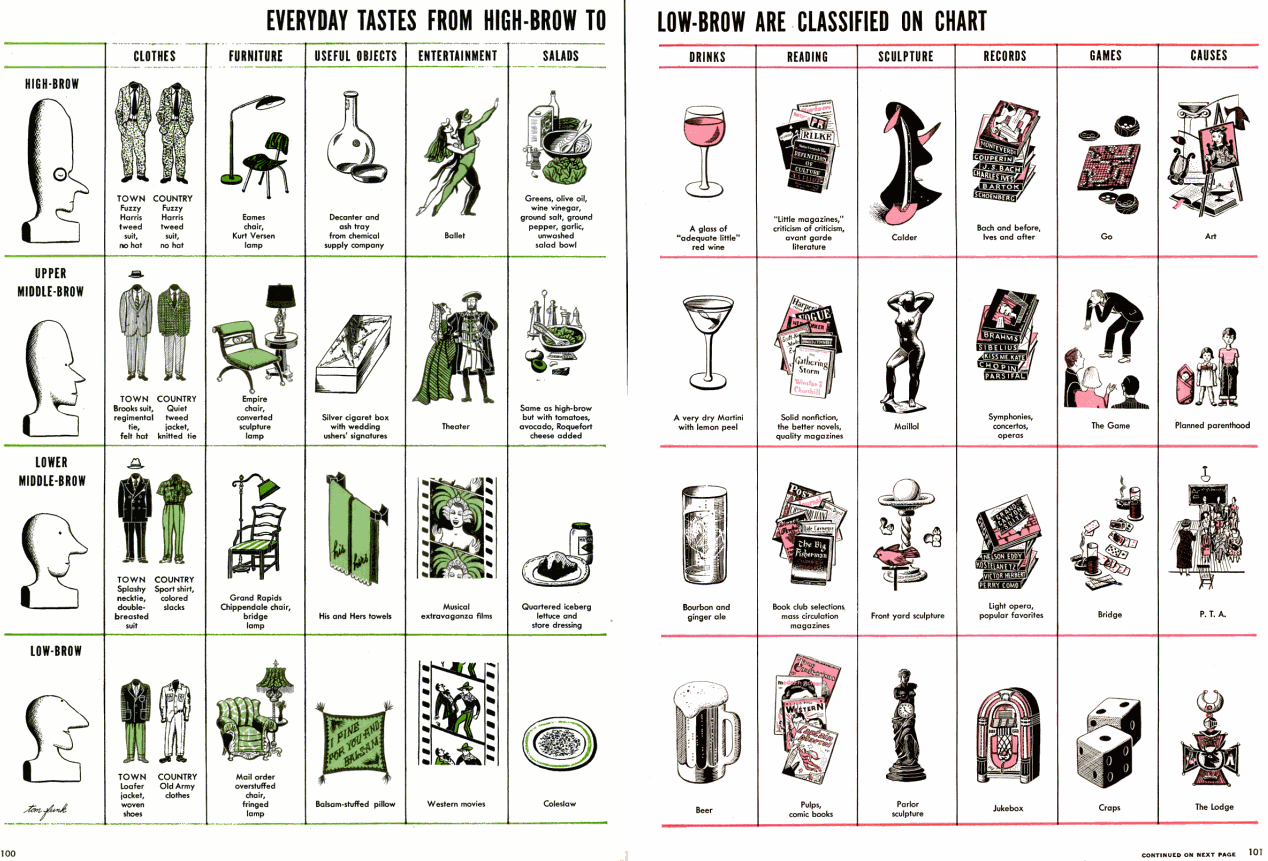
A hierarchy of tastes: the US, 1949

Long before Bourdieu published his essential book Distinctions, Life magazine, in 1949, published this chart, of High-Brow, Upper Middle-Brow, Lower Middle-Brow and Lowbrow tastes. I found it courtesy the blog of Kieran Healey.

Drinks: High = 'adequate little' red wine. Upper Middle = v. dry martini w/ lemon peel. Lower Middle = bourbon & ginger ale. Lower = beer.

And so on.

Click here for a larger version.


Sunday, August 26, 2012

Mods: Quadrophenia

The New York Times today (August 26, 2012) announces the reissue of the classic film about the Mods, Quadrophenia (1979), out on Blueray and DVD this Tuesday.

The film, says The Times, "concerns little more than a skinny 18-year-old West Londoner trying to track down some blues (speed) for one of these seaside gatherings turned tabloid-covered riots [between Mods and Rockers]. But the emotions that “Quadrophenia” elicits and its role in converting troubled souls to smartly dressed members of a movement (one with its own chant: “We are the Mods! We are the Mods!”) can be as forceful as the waves that open both the film and the Who’s 1973 double album...

Hallmarks of its style have included military-style parkas (often worn over pinstripe Italian suits), Clarks desert boots, Fred Perry polos, Vespa and Lambretta scooters, and bangs (for men and women)...

the film is driven largely by period music, stuff actual Mods would dance to: Booker T. and the MGs, the Ronettes."

Here's the trailer for the reissued version. Gorgeous.


And from the film's soundtrack, "Be My Baby" by The Ronettes.


Also from the soundtrack: Booker T and the MGs' "Green Onions."

Monday, August 20, 2012

Sony Walkman Commercials

1983?


The only cassette player as small as a cassette case.

My first Sony:


Japanese commercial, very 1980s.


A long Japanese one:

Sunday, July 08, 2012

The New Elitists: Cultural Omnivores

 
Craig Ward

Sociologist Shamus Khan, writing in the New York Times, July 8, 2012, on the tastes of today's elite. Some excerpts:

Poorer people are likely to have singular or “limited” tastes. The rich have the most expansive...Today’s elites are not “highbrow snobs.” They are “cultural omnivores.” 

Omnivorousness is part of a much broader trend in the behavior of our elite, one that embraces diversity...Diverse and populist programming is a mainstay of every museum. Elites seem more likely to confront snobbish exclusion than they are to embrace it...

To talk of “elite culture,” it seems, is to talk of something quaint, something anti-American and anti-democratic. Whereas the old elites used their culture to make explicit the differences between themselves and the rest, if you were to talk to members of the elite today, many would tell you that their culture is simply an expression of their open-minded, creative, ready-to-pounce-on-any-opportunity ethic. Others would object to the idea that they were part of an elite in the first place.  

But if you look at the omnivore from another point of view, a far different picture emerges.
Unlike the shared class character of Gilded Age elites, omnivores seem highly distinct and their tastes appear to be a matter of personal expression. Instead of liking things like opera because that’s what people of your class are supposed to like, the omnivore likes what he likes because it is an expression of a distinct self. Perhaps liking a range of things explains why elites are elite, and not the other way around. 

By contrast, those who have exclusive tastes today — middle-class and poorer Americans — are subject to disdain...

so if elites have a culture today, it is a culture of individual self-cultivation. Their rhetoric emphasizes such individualism and the talents required to “make it.” Yet there is something pernicious about this self-presentation. The narrative of openness and talent obscures the bitter truth of the American experience. Talents are costly to develop, and we refuse to socialize these costs. To be an outstanding student requires not just smarts and dedication but a well-supported school, a safe, comfortable home and leisure time to cultivate the self. These are not widely available...

Today America has less intergenerational economic mobility than almost any country in the industrialized world; one of the best predictors of being a member of the elite today is whether your parents were in the elite. The elite story about the triumph of the omnivorous individual with diverse talents is a myth...


[elites today] deploy that cultural difference to suggest that the inequality and immobility in our society is deserved rather than inherited.